

London, November 30, 2025
Leading companies in the maritime and additive manufacturing industries have achieved a breakthrough by producing fully 3D printed boats, significantly reducing construction time and costs while enhancing design capabilities. This innovation, emerging globally between 2023 and 2025, employs recyclable materials and automation to transform traditional boatbuilding.
Breaking Ground with 3D Printed Boats
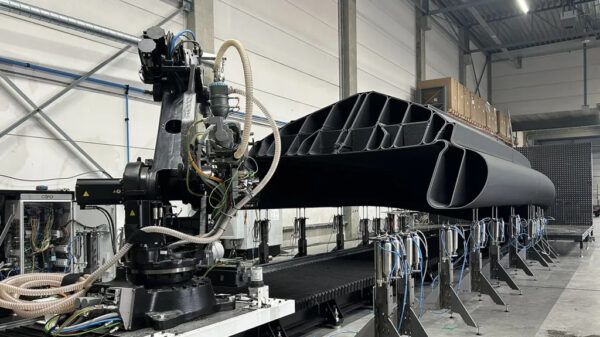
3D printing technology is rapidly disrupting traditional boatbuilding, which has long been labor-intensive and slow. Firms such as CEAD and Novieli Yachts have demonstrated the ability to print large-scale boat hulls within days rather than weeks or months. Utilizing robotic arms and continuous extrusion, companies have automated approximately 90% of the manufacturing process, dramatically accelerating production timelines. For instance, CEAD’s patented technology printed a fishing boat hull in 55 to 88 hours, marking a milestone in marine additive manufacturing.
Materials and Design Innovation
Central to this breakthrough is the development of advanced polymers like CEAD®HDPro, a 100% recyclable, impact-resistant material tailored for maritime conditions. These materials ensure hulls that are strong, durable, and require minimal maintenance. The 3D printing process allows for complex double hulls and stiffening ribs to be integrated seamlessly, improving structural integrity and stability. Moreover, by eliminating the need for molds and tooling, 3D printing enables intricate and lightweight hull designs that optimize fuel efficiency and wave handling, areas now further refined through generative AI-driven design optimization.
Sustainability and Market Impact
Sustainability is a defining feature of 3D printed boats. The recyclable nature of the materials opens pathways for closed-loop manufacturing, permitting end-of-life hulls to be shredded and reprinted, thereby reducing environmental impact. This ecological advantage aligns with global efforts toward greener manufacturing processes. The technology’s adaptability has also spurred applications in diverse markets: naval sectors benefit from on-demand unmanned vessel production; commercial operations gain from faster, custom boat fabrication; while recreational boating stands to advance through rapid prototyping and bespoke construction.
Future Outlook
Looking ahead, the integration of generative AI for design optimization and the potential for portable 3D printers to perform on-site repairs point to a future where production is not only faster and more flexible but also highly responsive to operational needs. New large-scale printing facilities are being established to meet growing demand, signaling that 3D printed boats are transitioning from innovative prototypes to an industrial standard in maritime manufacturing.
This technological advancement promises to reshape the marine industry by enabling faster, more sustainable, and customizable boat production—effectively launching a new era in maritime engineering.