

London, November 30, 2025
A significant breakthrough in boat manufacturing has emerged with the advent of large-scale 3D printing technology, revolutionizing traditional processes worldwide by dramatically reducing build times and costs while fostering sustainable and innovative design.
Rapid Automated Boat Production
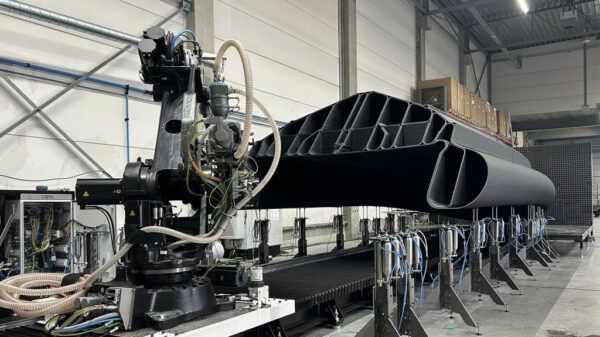
Large-scale 3D printing now automates up to 90% of the boat-building process, enabling the construction of boat hulls layer-by-layer using advanced robotic arms and extrusion systems. This innovation can reduce production cycles from the conventional weeks or even years down to a matter of days or weeks. For example, a functional navy boat hull was printed in just six weeks with substantially lower costs than traditional shipbuilding[1]. A full-sized fishing boat has also been completed in as little as 88 hours[2], showcasing the speed and efficiency gains.
Design Flexibility and Innovation
3D printing frees boat designers from the constraints of costly molds and tooling. This technology permits the creation of complex double-curved hulls and integrated features such as self-bailing decks and customized layouts, pushing both aesthetic and functional boundaries. These capabilities accelerate innovation cycles by allowing rapid prototyping of novel designs without the expense of traditional tooling or mold fabrication[5][6].
Material Advances for Durability
New materials like CEAD®HDPro—a high-performance thermoplastic that is impact-resistant and fully recyclable—enable printed boats to withstand rough marine conditions and support powerful engines. These thermoplastics not only ensure durability but also align with environmental goals by being recyclable, encouraging a circular manufacturing approach[4][5].
Sustainability and Waste Reduction
Compared to conventional boatbuilding methods, additive manufacturing produces significantly less material waste. The ability to utilize eco-friendly and recycled materials further enhances sustainability in the maritime sector. This aligns with broader commitments to reduce environmental impact and embraces cleaner production practices[6].
Military and Commercial Applications
Beyond commercial fishing vessels, 3D printing also serves military needs by supporting rapid, on-site construction of unmanned vessels and drones tailored to specific operational requirements. For instance, prototypes tested by NATO Special Forces demonstrate the potential for scalable, mission-adapted nautical drones produced through 3D printing in compact, urban-friendly facilities[1].
Cost Efficiency and Fast Iteration
Traditional boatbuilding is labor-intensive and costly, often requiring years and significant budgets to complete complex vessels. In contrast, 3D printed boats reduce labor demands and expenses markedly while enabling fast iteration cycles that facilitate learning and reproducibility. This cost efficiency opens the door for more adaptive manufacturing responsive to market and operational changes[1].
Implications for Industry and Future Trends
The technology’s ability to deliver cleaner, quieter, more compact production centers in urban environments positions it as a disruptive force in the maritime industry. Its scalability and flexibility could reshape commercial and military boat manufacturing, accelerating innovation and sustainability. Continued advancements and pilot projects signal that 3D printed boats may become mainstream within the next five years[8].
This transformation represents a convergence of automation, materials science, and design innovation, offering a sustainable and economically viable future for boatbuilding on a global scale.