

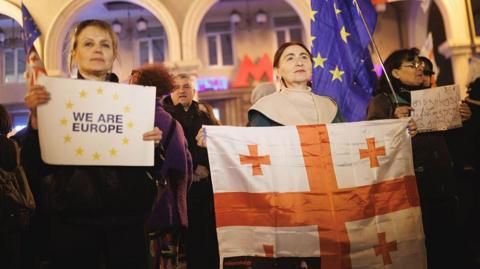
Tbilisi, November 28, 2025
Georgians have marked a year of continuous anti-government protests across the country, sustaining resistance against political repression and the suspension of the EU accession process that began in late 2024. Demonstrators demand democratic reforms, new elections, and renewed European integration.
Ongoing Protests and Background
The protest movement started on October 28, 2024, following disputed parliamentary elections widely criticized for fraud by opposition groups and international monitors. After the ruling Georgian Dream party suspended Georgia’s bid for European Union membership on November 28, 2024, mass demonstrations intensified. Over the past year, protests have persisted without interruption, becoming one of Europe’s longest-running movements in recent decades.
Protesters call for fresh parliamentary elections overseen by international observers, reinstatement of the EU accession initiative, and a reversal of government’s growing pro-Russian foreign policy stance. They also demand the release of political prisoners detained amid the protests and an end to state-sponsored repression of dissent.
Government Crackdown and Repression
Authorities have responded with increasing force. Security services routinely deploy water cannons, tear gas, and conduct mass arrests during demonstrations. Currently, more than 120 political detainees remain imprisoned, and thousands have faced fines or short-term incarceration. Journalists covering events have endured over 600 documented attacks in the last twelve months, contributing to a sharp decline in press freedom.
The government has enacted stringent new laws imposing harsh penalties on protest activities, including detention and heavy fines for blocking public roads. These measures have intensified tensions and drawn widespread condemnation.
Symbolic Acts and Key Events
Protesters have employed symbolic forms of resistance, organizing human chains in major cities and conducting prayer services led by defrocked clergy, invoking Georgia’s historical struggles for independence. Important dates such as the anniversary of the 1921 fall of the Democratic Republic of Georgia are commemorated annually in protest contexts.
A significant rally was held on November 28, 2025, coinciding with the first anniversary of the EU bid suspension, where activists pledged to maintain their struggle for democratic governance and European integration despite the risks involved.
International Reactions and Warnings
The European Commission has consistently expressed support for Georgia’s civil society and called on the Georgian government to cease the use of intimidation and violent suppression against peaceful demonstrators. Human rights organizations and international observers have condemned governmental actions, noting a worrying trend of democratic erosion within the country.
Implications for Georgia’s Future
The prolonged protest movement reflects a broad national consensus favoring democracy and Western integration, standing in opposition to authoritarianism and Russian influence. It highlights the resilience of Georgian civil society amid severe political hardship and repression.
Commenting on the protests, Tbilisi demonstrator Giorgi Arabuli stated, “They can’t crush our protests. We will keep fighting for our future, for our country, and for Europe.”
As Georgia navigates competing internal and external pressures, this persistent popular resistance underscores the high stakes for political stability and democratic development in the region.