

London, December 02, 2025
India’s Aditya-L1 mission is set to observe the Sun at its most active phase during the Solar Maximum in 2026 from its strategic position at the Earth-Sun Lagrange Point 1, enabling critical real-time scientific data collection to enhance understanding of solar dynamics and improve space weather forecasting.
2026 and the Solar Maximum
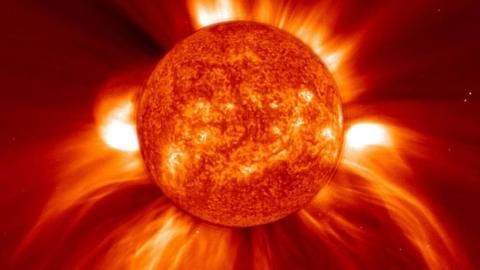
The year 2026 marks the peak of Solar Cycle 25, a roughly 11-year oscillation in solar activity. This Solar Maximum phase brings heightened solar phenomena, including more frequent solar flares, coronal mass ejections (CMEs), and increased sunspot activity. These conditions create an invaluable scientific window to analyze extreme solar behavior.
Aditya-L1’s Observation Advantage
Stationed at the Lagrange Point 1 (L1), a gravitational balance point between Earth and the Sun, the Aditya-L1 spacecraft has a continuous and unobstructed view of the Sun. This positioning enables it to capture uninterrupted, real-time data on solar activity, essential for studying the phenomena that peak during the Solar Maximum.
Scientific and Practical Significance
Data collected by Aditya-L1 will provide comprehensive insights into solar events, which are critical not only for advancing astrophysics but also for practical applications. Enhanced understanding of solar flares and CMEs can improve predictions of solar storms that potentially disrupt satellite operations, terrestrial power grids, and communication systems.
India’s Emerging Role in Solar Research
The mission highlights India’s growing presence in global solar science. By contributing advanced observational capabilities during one of the most active solar periods in recent decades, Aditya-L1 positions India as a key player in space science research and international efforts to mitigate the impacts of space weather on Earth.
Context of the Solar Cycle
The Sun’s approximately 11-year solar cycle governs the waxing and waning of activity characterized by sunspots and solar eruptions. Solar Cycle 25 culminates in 2026, offering a rare scientific opportunity to investigate solar phenomena under extreme conditions.
A Once-in-a-Decade Opportunity
The convergence of peak solar activity with the sophisticated instrumentation aboard Aditya-L1 makes 2026 a unique year for solar observation. No other year in the current cycle will provide such a rich combination of data, giving scientists a rare chance to deepen our understanding of the Sun’s influence on the space environment.
By monitoring the Sun throughout this critical period, Aditya-L1 will deliver data that not only advance fundamental solar science but also inform technological resilience planning on Earth and future space exploration initiatives.