

London, December 02, 2025
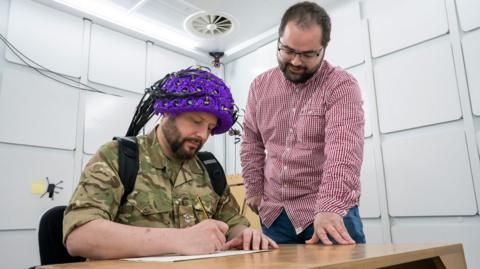
The University of Nottingham has introduced the world’s first fully mobile quantum brain scanner, designed to measure the real-time effects of blast exposure on the brain. This technology, funded by the UK Ministry of Defence, will be deployed directly to military and medical facilities to improve understanding and management of blast-related brain injuries.
World’s First Mobile Quantum Brain Scanner
The novel device represents a significant advance in neuroimaging technology. Unlike traditional brain scanners that require stationary and controlled environments, this mobile unit uses cutting-edge magnetoencephalography (MEG) based on quantum sensor technology to conduct brain scans in various field settings. Its portability allows for immediate assessment of brain function following blast exposure.
Technology and Deployment
This scanner applies MEG technology, which measures brain activity by detecting magnetic fields produced by neural electrical currents. The system is uniquely adapted for mobile use without sacrificing the sensitivity and precision of stationary clinical MEG machines. Developed through collaboration between the University of Nottingham, the University of Birmingham, and the University of Nottingham spin-out Cerca Magnetics, the project received over £3 million in investment from the Ministry of Defence. The device will primarily support Defence Medical Services, enabling on-site brain monitoring at firing ranges, field hospitals, and rehabilitation centers.
Research Implications and Military Impact
The deployment marks a pivotal enhancement in military medicine and blast injury research. For the first time, scientists and clinicians can compile an accurate, time-stamped record of brain function changes within minutes and hours after blast exposure, enabling detailed tracking of recovery trajectories. This data will help identify which weapon types pose the greatest risks and support evidence-based guidelines to establish safe exposure limits for military personnel. Lt Col James Mitchell, Chief Investigator of the UK Military Blast Study, emphasized that this system will underpin scientifically informed policies for blast safety protocols.
Broader Clinical and Research Applications
Beyond its military utility, the mobile quantum brain scanner shows promise for a range of neurological research fields. It is expected to contribute valuable insights into sports concussion management, dementia progression, and epilepsy treatment by offering objective and immediate brain function assessments. This adaptability positions the technology as a potential catalyst for advances across multiple areas of brain health and neurological disorder research.
The introduction of this mobile quantum brain scanner sets a new standard in neurodiagnostic capabilities, bridging the gap between advanced brain imaging and real-world settings. As it becomes integrated into military and civilian medical practice, it holds potential to transform brain injury detection, inform safer operational practices, and expand scientific understanding of brain dynamics following traumatic events.