

New York, November 27, 2025
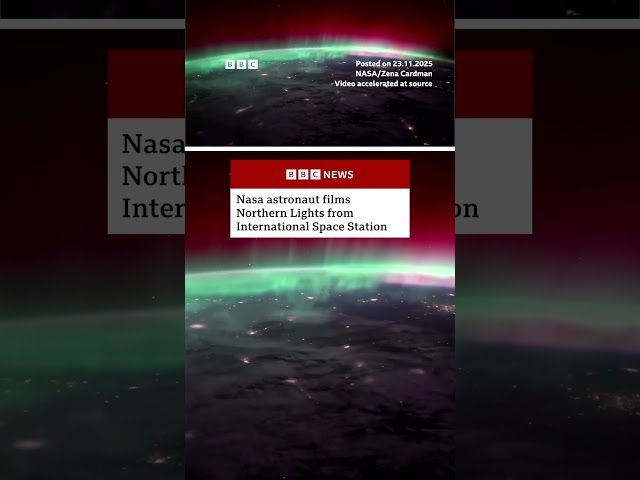
NASA astronaut Zena Cardman captured vivid footage of the Northern Lights from the International Space Station on November 17, 2025, offering a rare orbital view of the aurora borealis over the United States and highlighting the ongoing importance of space-based scientific observation.
Captured from Orbit
On November 17, 2025, Zena Cardman, commander of NASA’s SpaceX Crew-11 mission aboard the International Space Station, filmed the aurora borealis, also known as the Northern Lights. This footage presents a unique perspective of the natural light display, typically visible from Earth’s polar regions, but rarely seen from space with such clarity and scale. Cardman, who noted she has never witnessed the aurora from the ground, emphasized the dynamic and frequent appearance of this phenomenon from orbit.
Understanding the Aurora Borealis
The aurora borealis is created by charged particles emitted from the sun interacting with Earth’s magnetic field and atmosphere. When these particles collide with gases in the upper atmosphere, they emit light that manifests as the colorful, shimmering displays in polar skies. Observing this phenomenon from space allows scientists to view the full extent and shape of the auroral oval—information that is difficult to capture from the ground.
Scientific and Visual Importance
This orbital vantage point provides critical data that contribute to the study of space weather and atmospheric physics. The aurorae are indicators of interactions between solar activity and Earth’s magnetic environment, which can impact satellite operations, communication systems, and power grids. The footage captured by Cardman thus not only offers stunning visuals but also supports ongoing research in planetary science and space weather forecasting.
Access and Observation
The full video of the Northern Lights as filmed from the ISS is available online through NASA partners such as ABS-CBN News and No Comment TV (Euronews) on YouTube. Viewers are encouraged to identify landmarks including major U.S. cities like Houston and regions of Florida illuminated beneath the auroral glow.
Broader Implications
This event underscores the value of the International Space Station as a platform for both scientific research and public engagement, providing breathtaking imagery that connects global audiences to Earth’s natural phenomena from a novel perspective. Such space-based observations continue to be vital for advancing climate and atmospheric understanding, informing policy and academic discourse, and inspiring broader interest in space exploration.