

Washington, D.C., November 28, 2025
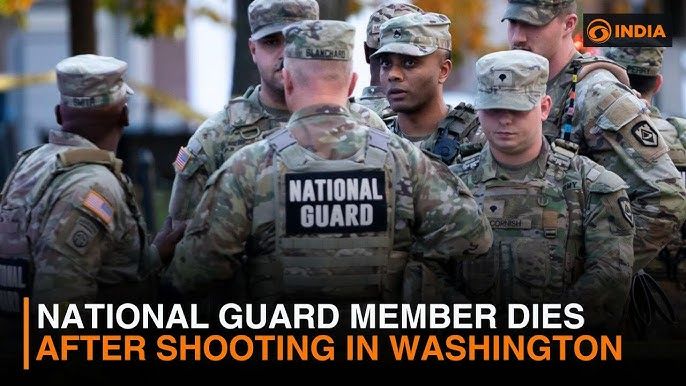
A shooting near the White House on November 26 resulted in the death of a newly sworn-in West Virginia National Guard member and left another critically wounded after being ambushed by a gunman who was subsequently detained. The incident has triggered a federal investigation and heightened security measures in the capital.
Details of the Shooting and Victims
The attack took place around 2:15 p.m. near the Farragut West Metro station, roughly two blocks northwest of the White House. The assailant, identified as Rahmanullah Lakanwal, used a .357 magnum Smith & Wesson revolver to fire 10 to 15 shots targeting two National Guard soldiers. Both soldiers sustained gunshot wounds to the head. One of the victims returned fire, wounding the suspect before law enforcement took him into custody.
Specialist Sarah Beckstrom, 20, succumbed to her injuries as confirmed by President Trump during a Thanksgiving call with U.S. troops. Staff Sergeant Andrew Wolfe, aged 24, remains in critical condition following surgery. Both had been sworn into service less than 24 hours prior to the incident, emphasizing the suddenness and severity of the attack.
Suspect’s Background and Investigation Status
The alleged shooter, Rahmanullah Lakanwal, is a 29-year-old Afghan national originally from Khost Province. He arrived in the United States as part of Operation Allies Welcome in September 2021 and had initially overstayed his visa before being granted asylum in April 2025. Notably, Lakanwal previously worked alongside U.S. forces in Afghanistan as part of a CIA-backed unit within the Afghan National Directorate of Security. Federal authorities note that the suspect drove cross-country from Bellingham, Washington, with the apparent intention of reaching Washington, D.C.
After the exchange of gunfire in which Lakanwal was shot four times, he was hospitalized with non-life-threatening injuries. At present, he is not cooperating with investigators. The U.S. Attorney General has announced plans to pursue terrorism-related charges and is seeking a life sentence.
Official Response and Security Implications
The National Guard has been deployed in Washington, D.C., since August 2025 under a federal initiative aimed at reducing crime. At the time of the attack, approximately 2,188 Guard members were stationed in the capital. Following the shooting, Defense Secretary Pete Hegseth reported that President Trump requested an additional 500 troops to enhance security.
President Trump described the shooting as “an act of evil, an act of hatred and an act of terror,” underscoring its significance as a direct affront to the nation. This event has intensified debate regarding the National Guard’s presence in the city, with local authorities previously voicing concerns about federal overreach and jurisdictional authority.
Context and Broader Implications
The incident highlights ongoing security challenges in the nation’s capital amid heightened crime prevention efforts. The fact that both victims were newly sworn-in Guard members underscores vulnerabilities even within protective forces recently mobilized for domestic security.
The suspect’s background, including his prior association with U.S. intelligence operations and subsequent asylum process, adds complexity to immigration and national security discussions. Authorities continue to investigate the motive and any potential connections to broader threats.
This tragic event not only impacts immediate security protocols but also raises questions related to cross-agency coordination, the scope of the National Guard’s deployment, and the balance between federal and local governance in the capital.
The unfolding investigation and legal proceedings are expected to provide further clarity on the attack’s dynamics and inform future counterterrorism and public safety strategies in Washington, D.C.