

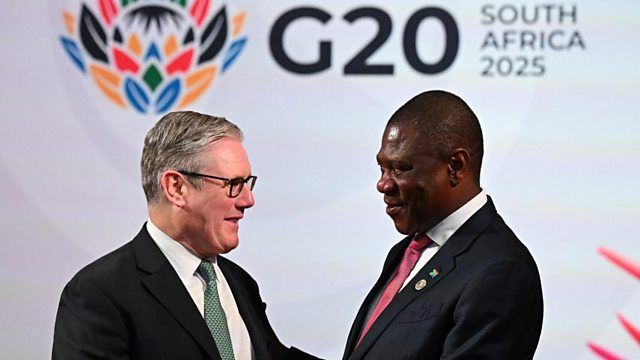
Johannesburg, November 23, 2025
US President Donald Trump’s boycott of the 2025 G20 Summit in South Africa has dominated global headlines, overshadowing South Africa’s historic role as the first African host and complicating diplomatic ties on November 22–23. The US absence was driven by contested allegations against South Africa, deepening geopolitical tensions.
Trump’s Boycott and US Absence
President Trump publicly announced his decision to boycott the summit, citing disputed claims of human rights abuses against South Africa’s white minority, assertions widely discredited by international observers. The United States refrained from sending a delegation to engage in official talks, only dispatching a chargé d’affaires for the customary handover ceremony—a move South Africa declined to accept.
In reaction to the boycott, the US government took further diplomatic steps, expelling South Africa’s ambassador, reducing aid packages, and imposing new tariffs, marking a significant strain in bilateral relations.
Media Focus and Diplomatic Fallout
The boycott quickly became the focal point of international media coverage, diverting attention from South Africa’s ambitions to highlight critical issues affecting developing countries. South African President Cyril Ramaphosa expressed open frustration, remarking that the handover to the US would be made to an “empty chair,” underscoring the diplomatic rupture.
Impact on Summit Outcomes
Experts have noted that the absence of key leaders, particularly from the US, diminished the summit’s capacity to produce robust, unified declarations. The final leaders’ declaration on urgent global challenges—including food security, disaster resilience, and sustainable finance—was adopted without input or endorsement from the United States. This has tempered expectations for global cooperation and implementation of the summit’s agenda.
South Africa’s Persistent Agenda
Despite these diplomatic hurdles, South Africa leveraged the summit platform to advance several priorities central to developing nations. These included calls for fairer sovereign credit ratings to reduce borrowing costs, enhanced climate finance commitments to support a just energy transition, and greater African participation in multilateral forums. South Africa also emphasized equitable access to critical minerals essential for global energy and technological transitions.
These efforts reflect the country’s ongoing commitment to championing development and sustainability issues within global governance structures, illustrating the summit’s significance beyond the US’s absence.
While Trump’s boycott introduced complications and diluted some outcomes, it did not fully eclipse South Africa’s G20 moment. The summit remains a landmark event for Africa’s role in global economic discourse, even as it highlights persistent geopolitical divisions and the challenges of fostering consensus in an increasingly fractious international landscape.