

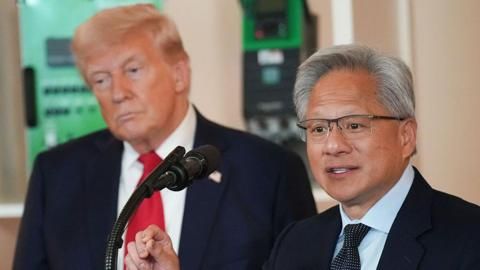
New York, December 09, 2025
Former U.S. President Donald Trump has authorized Nvidia to sell its advanced H200 AI chips to approved customers in China, with a requirement that the U.S. government receives a 25% share of chip sales, marking a notable shift in U.S. export policy amid strategic concerns over technology security and competition.
Details of the Agreement
The approval permits Nvidia to export its H200 AI chips to selected Chinese customers under strict conditions designed to safeguard U.S. national security interests. Importantly, this concession excludes Nvidia’s more advanced Blackwell and upcoming Rubin chip systems, which remain restricted from sale to China. In addition to the export permission, the U.S. government will take a quarter of revenue generated from these chip sales.
This move signals a pragmatic recalibration of earlier export controls, signalling an adaptation in policy that weighs both commercial opportunity and geopolitical considerations. The U.S. Department of Commerce is currently finalizing the implementation framework.
Reactions and Industry Impact
Nvidia’s CEO, Jensen Huang, who has publicly advocated for easing restrictions, welcomed the development. He argued that strict export bans were accelerating China’s efforts to domestically produce competitive AI chips, which could ultimately reduce U.S. influence in the global AI technology race. Following the announcement, Nvidia’s stock price responded positively, reflecting investor optimism about the expanded access to the lucrative Chinese market.
This policy adjustment is expected to extend to other major American chipmakers, such as AMD and Intel, broadening the impact across the semiconductor sector.
Chinese President Xi Jinping was directly informed of the decision by Trump and reportedly responded favorably, indicating a positive diplomatic exchange tied to this technology trade agreement.
Context and Previous Policy Landscape
The U.S. previously maintained stringent export controls on advanced AI semiconductor technologies under the Biden administration, driven by concerns over potential Chinese military applications and ambitions to dominate AI development globally. These measures severely limited U.S. chipmakers’ ability to sell cutting-edge AI processors in China, which is both a major consumer and competitor in AI technologies.
This shift demonstrates a nuanced approach balancing national security risks against economic and strategic imperatives to maintain technological leadership through engagement rather than isolation.
Allowing limited exports with revenue sharing and excluding certain high-end chips aims to protect sensitive technology while accommodating commercial interests and fostering regulatory oversight.
The emerging framework also reflects broader U.S.-China tech relations dynamics and the increasing importance of semiconductor technology in global geopolitical competition and economic strategy.
As U.S. authorities finalize regulations and extend similar agreements to additional firms, the semiconductor sector and AI industry will closely observe how these new export policies influence innovation, market access, and the high-stakes rivalry for AI supremacy on the world stage.